The Miami-Dade Back Bay Coastal Storm Risk Management Feasibility Study, often referred to as MDBB CSRM, is an ongoing study effort led by the U.S. Army Corps of Engineers (USACE) in partnership with Miami-Dade County that was originally initiated in 2018 under the authority of Public Law 84-71, June 15, 1955. Public Law 84-71 authorizes an examination and survey of the coastal and tidal areas of the eastern and southern United States, with reference to areas where severe damage has occurred from hurricane winds and tides. The study is fully federally funded, meaning there is no direct study cost to the Nonfederal Sponsor, Miami-Dade County.
Study Phase 2 (2024 – 2027; Current)
With completion of the signed Chief’s Report in August 2024, the USACE and Miami-Dade County project team is now focusing on a new iteration of feasibility analyses that expand upon the initial recommendations that were authorized in WRDA 2024. This study effort, which the team refers to as “Study Phase 2” is currently underway and aims to follow a more typical USACE feasibility study timeline for reaching a signed Chief’s Report by August 2027. The current feasibility analysis includes 11 new focus areas that are being considered for nonstructural measures consistent with the analyses that supported the 2024 Recommendation – Biscayne Canal Expansion South, Edgewater, Florida City, Homestead, Little River Expansion East, Miami River Expansion East, Miami River Expansion West, Morningside, Normandy Isle, North Bay Village, and Saga Bay. Miami River Expansion East, Miami River Expansion West, Morningside, Normandy Isle, North Bay Village, and Saga Bay.
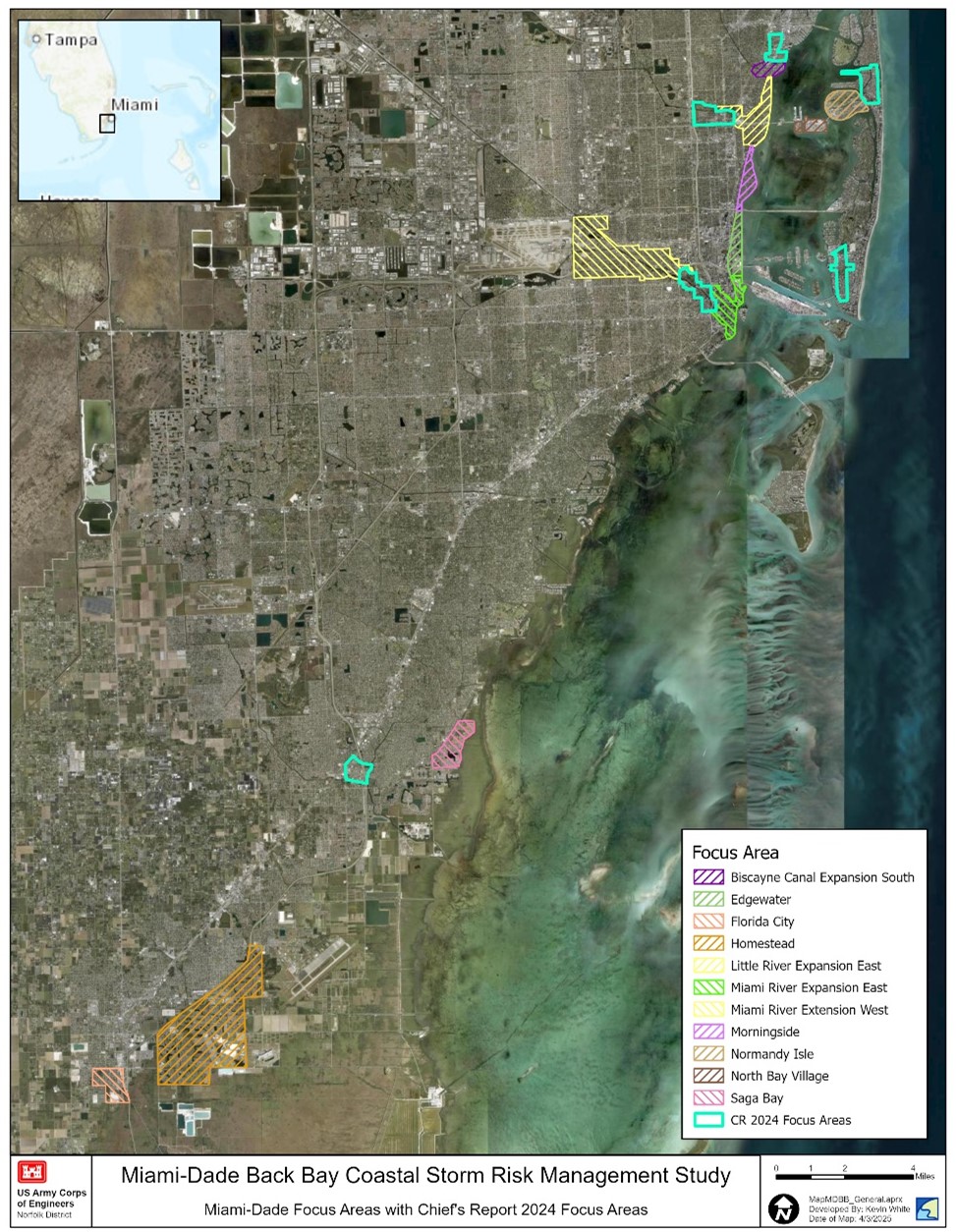
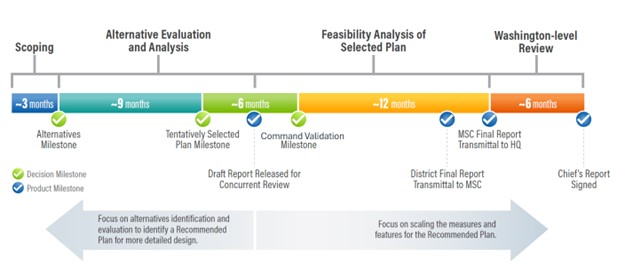
What’s Next: The project team compiled an initial array of nonstructural alternatives using the updated focus areas at the first key study milestone, the Alternatives Milestone Meeting, in January 2025. Currently, the alternatives are undergoing initial evaluations and analyses to quantify their potential benefits, costs, and impacts to the economy, public, and environment. These, along with additional considerations of life safety, risk and level of performance, and feedback from community members and stakeholders, will inform the alternative that USACE and Miami-Dade County select and propose at both the Tentatively Selected Plan Milestone and in the upcoming draft feasibility report that will be publicly released for further input in 2026.
Background and Study History (2018 – 2023)
Originally, the feasibility study was slated to begin in October 2018 and conclude in October 2021 with a report that is signed by the Chief of Engineers (commonly known as a Chief’s Report) that is then transmitted to Congress for authorization to proceed with design and implementation. During that original study effort, a draft feasibility report was released to the public in June 2020 that proposed a combination of nonstructural and structural measures to manage coastal storm risk in Miami-Dade County. However, the study did not progress to completing a final report largely due to the public feedback and community-wide concerns that the USACE and Miami-Dade County team received regarding the proposed structural measures as described in the draft report. In response to the unified feedback calling for further consideration of potential solutions along with the unique sensitivity of the valuable environmental resources and complexity of the existing water resources challenges within Miami-Dade County, the USACE and Miami-Dade County project team pursued the formal process to request additional time and funding for continuation of the study effort. This request was approved by the Assistant Secretary of the Army for Civil Works (ASA(CW)) in August 2022, and so the study, and the effort to formulate and consider additional solutions that could both manage coastal storm risk and be supported by the Miami-Dade community, commenced.
 In following conversations with the USACE leadership team and the ASA(CW), it was determined that the urgency of the immediate CSRM needs of Miami-Dade County called for a modified study strategy to advance an initial set of solutions more quickly; thus the team received study guidance in December 2023 to undertake a multi-phased risk management approach that utilized the opportunity for authorization of a set of measures to advance to design and implementation via the Water Resources Development Act (WRDA) of 2024.
Study Phase 1 (2023 - 2024)
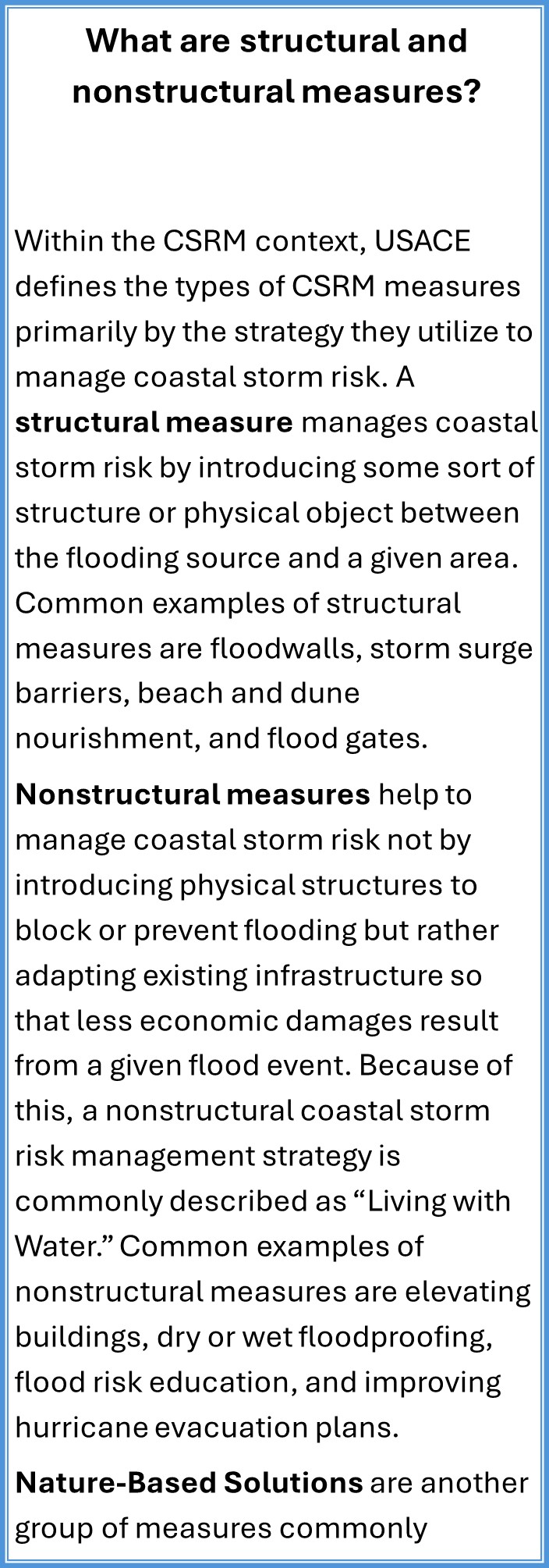
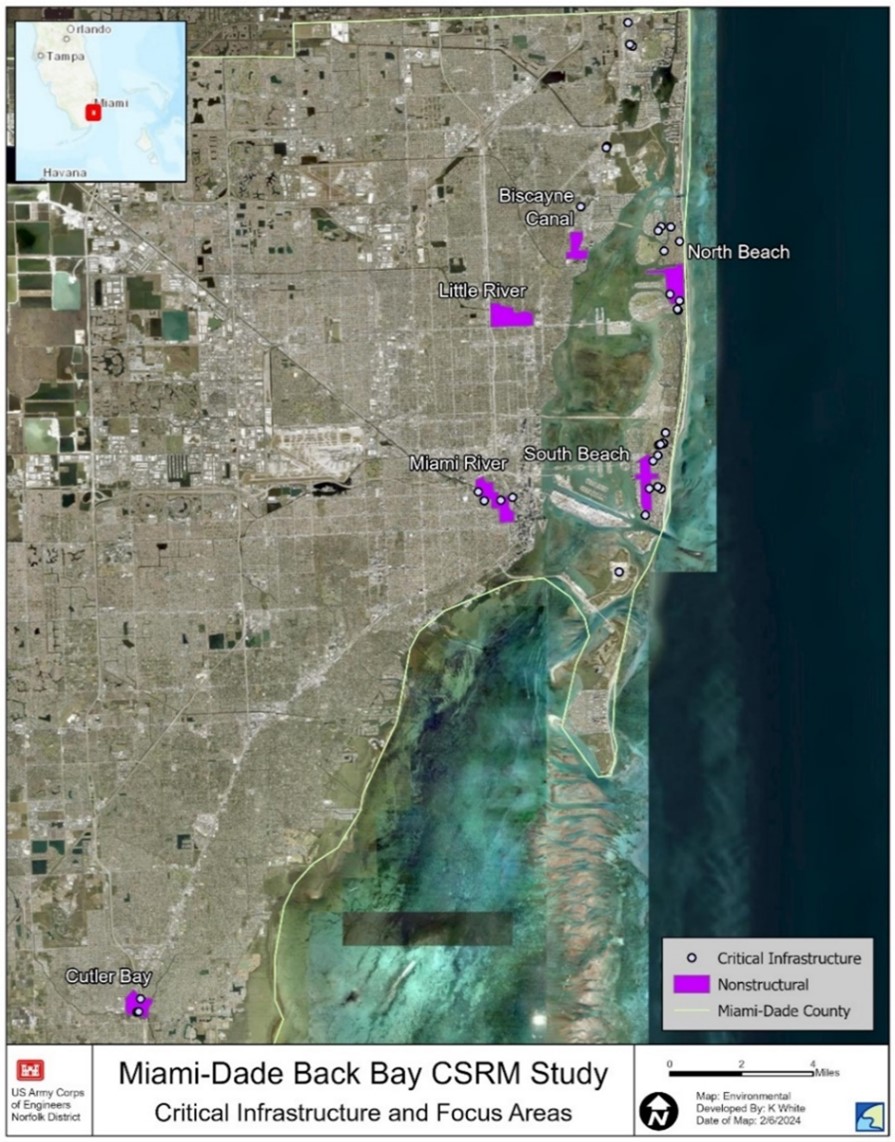
The team embarked on the charge to recommend an initial set of CSRM solutions in a signed Chief’s Report in under ten months to be eligible for inclusion in the WRDA of 2024 by focusing the scope to prioritize nonstructural measures in the communities of Miami-Dade County that are particularly vulnerable and at-risk to coastal storms. Ultimately, the Chief’s Report, which was signed by the Chief of Engineers on August 26, 2024, reflected a Recommended Plan that included floodproofing of up to 27 critical infrastructure facilities and 403 nonresidential buildings, as well as elevating up to 2,052 residential buildings across six focus areas. Those focus areas, Biscayne Canal, Little River, North Beach, South Beach, Miami River, and Cutler Bay, represented some of the areas within the county that are most vulnerable to coastal storm risk. The Chief’s Report was successfully authorized in WRDA 2024, marking the end of the approximate 10-month effort referred to as “Study Phase 1”, and the project is currently awaiting federal appropriations to begin the Pre-Construction Engineering and Design (PED) Phase.
In addition to the Recommended Plan, the signed Chief’s Report also included recommendations for Congress to create and fund both a Nature-Based Solutions Pilot Program and a Nonstructural Programmatic Study in Miami-Dade County to inform the tools, policies, and practices available to USACE for improved ability to utilize both Nature-Based Solutions and complex nonstructural measures in future feasibility studies nationwide.